Ministry of Natural Resources Ministry of Agriculture and Rural Development National Forestry and Grassland Authority Circular on the improvement of the management of agricultural land in facilities
Natural resources (2026) Number 146.
The natural resources authorities of the provinces, autonomous regions, municipalities directly under the Central Government, the agricultural and rural authorities, the forestry and grassland authorities, the Natural Resources Directorate of the Xinjiang Corps of Production and Construction, the Agricultural and Rural Directorate and the Forestry and Grassland Directorate:
In order to follow up on Central Document No. 1 of 2026 and to further improve the management of agricultural land in facilities in the context of maintaining the red line for the protection of arable land, to promote increased incomes for the rural population and to contribute to the modernization of agriculture and rural renewal, the following information is provided:
I. Distinction of agricultural land for facilities
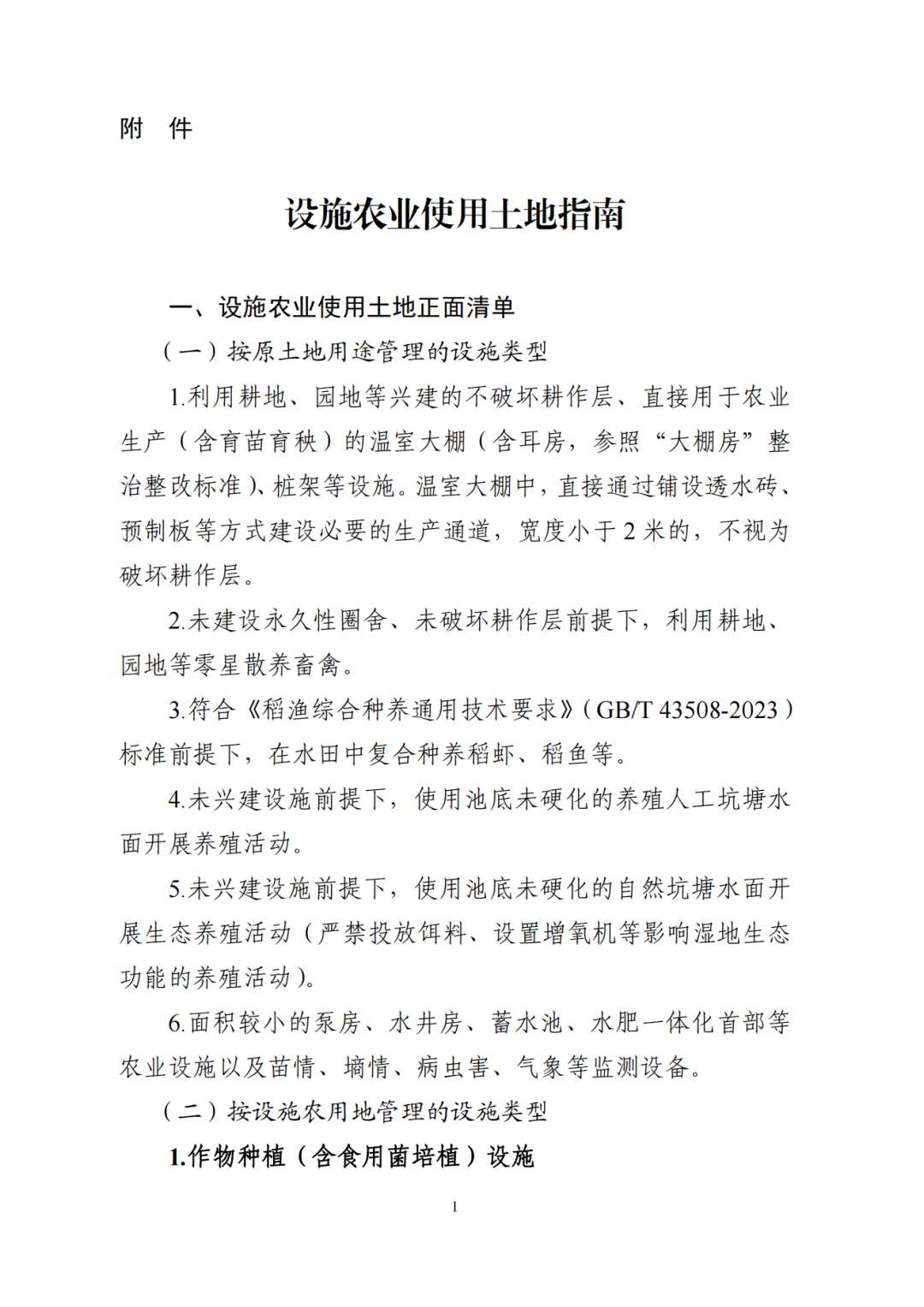
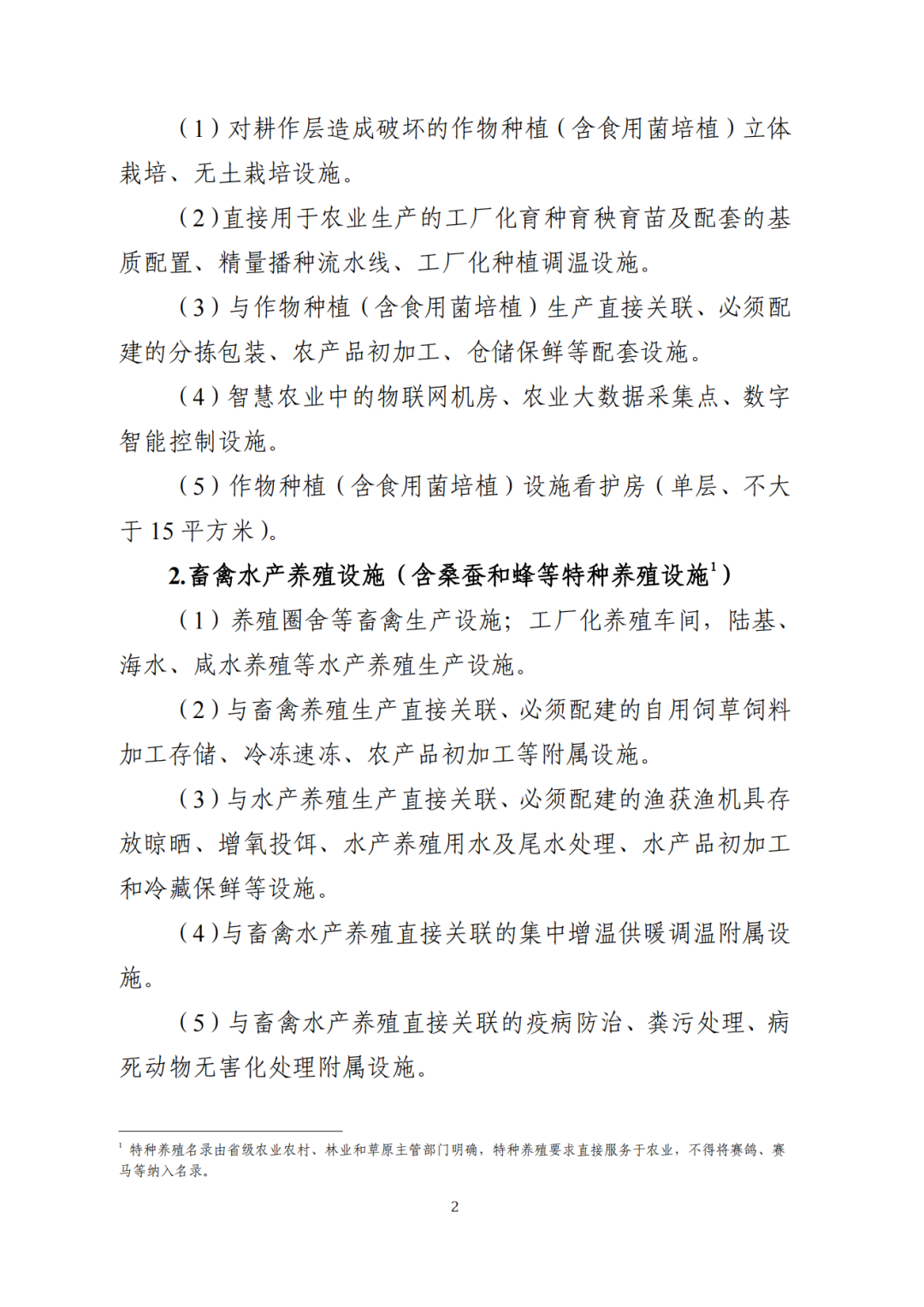
Facilities agriculture is an engineering tool that provides relatively controlled environmental conditions for plant and animal growth, moving to some extent away from the type of agriculture that naturally depends on efficient production. Land used for the development of facilities is subject to differentiated management through the “positive list of land used for facilities in agriculture” (see annex), in accordance with the Land Use Classification (GB/T 21010-2017), the Guidelines for the Classification of Land Use for Territorial Spatial Survey, Planning, Use Control of Land Use and the Relationship of the Facility to Agricultural Production:
(i) Management by original land use: facilities that do not cause damage to farming layers, as well as facilities such as hydro- and fertilizer integration of smaller fields, need not be subject to land procedures.
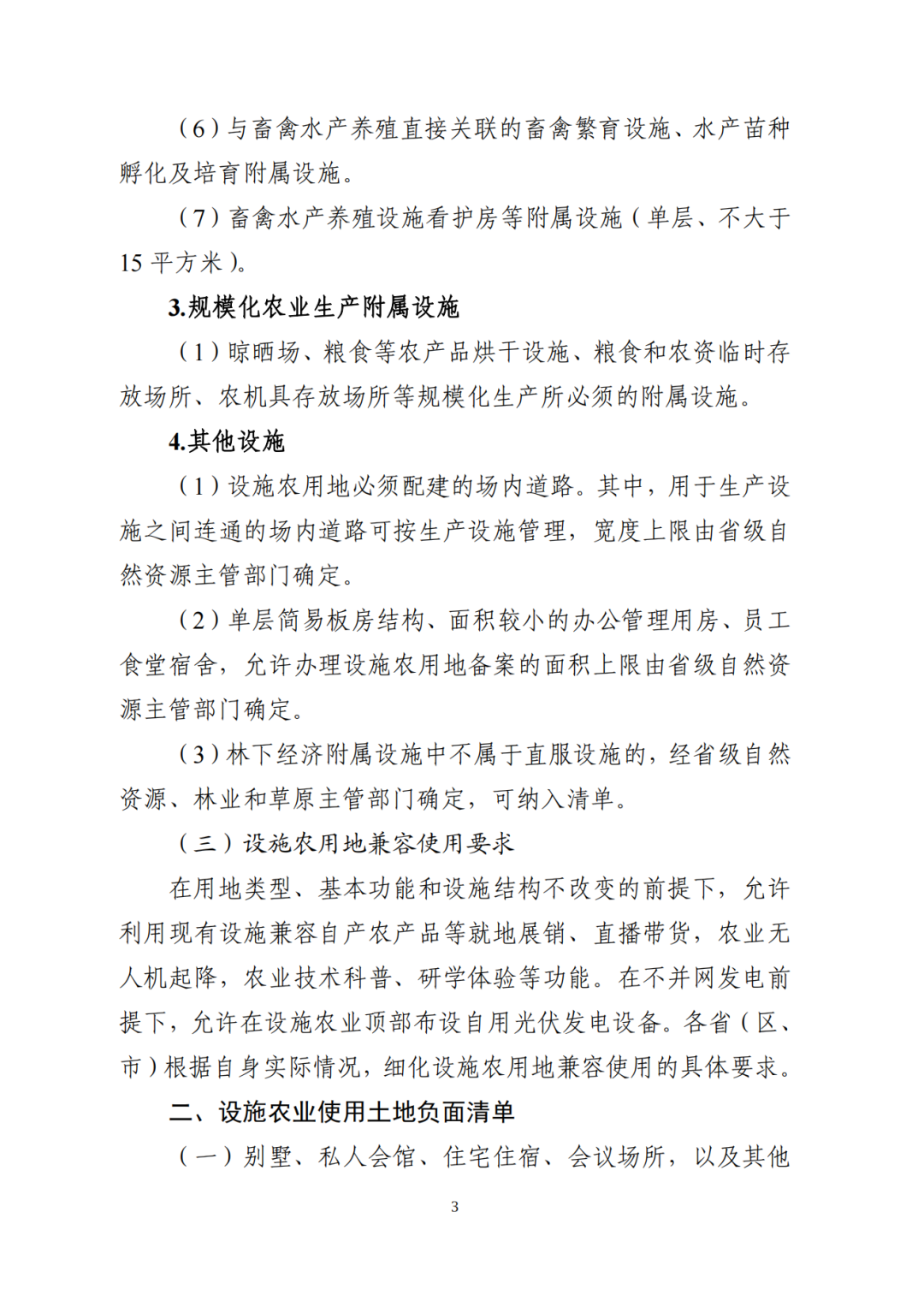
(ii) Administration of agricultural land by facilities: damage to farming layers, farming production and ancillary facilities that directly serve agricultural production, as well as facilities attached to scaled agricultural production, etc., require processing of agricultural land for facilities.
(iii) Land management by construction: Facilities not included in the “Focus list of agricultural land for facilities” in facilities agriculture shall be subject to approval of land for construction; facilities included in the “Focus list of agricultural land for facilities” may apply for approval of land for construction if the owner so wishes.
II. Selection of agricultural sites for integrated facilities
Based on the Land Spatial Plan, “a map”, it is clear that the general rules-based location requirements for agricultural land in facilities are required, and that the infrastructure agriculture, particularly the scalable farming industry, is actively directed to provide security for the development facilities agriculture of the main operators. The county-level agricultural and rural authorities, together with the county-level natural resources, forestry and savannah authorities, take into account, in conjunction with the territorial spatial planning (village planning), the regulatory aspects of other sectors, such as the ecological environment and water, and guide the operators in the selection of their sites. The use of unused land (excluding wetlands as defined in the Wetlands Protection Act), stock-building land and all types of unused land is encouraged in the selection of agricultural land for facilities, allowing for the occupation of arable land other than the basic permanent agricultural land. In the case of large-scale chemical plant facilities, livestock farming facilities permit the occupation of forest lands and grasslands, aquaculture ancillary facilities (excluding production facilities) and other types of facilities do not.
III. Rational control of agricultural land in facilities
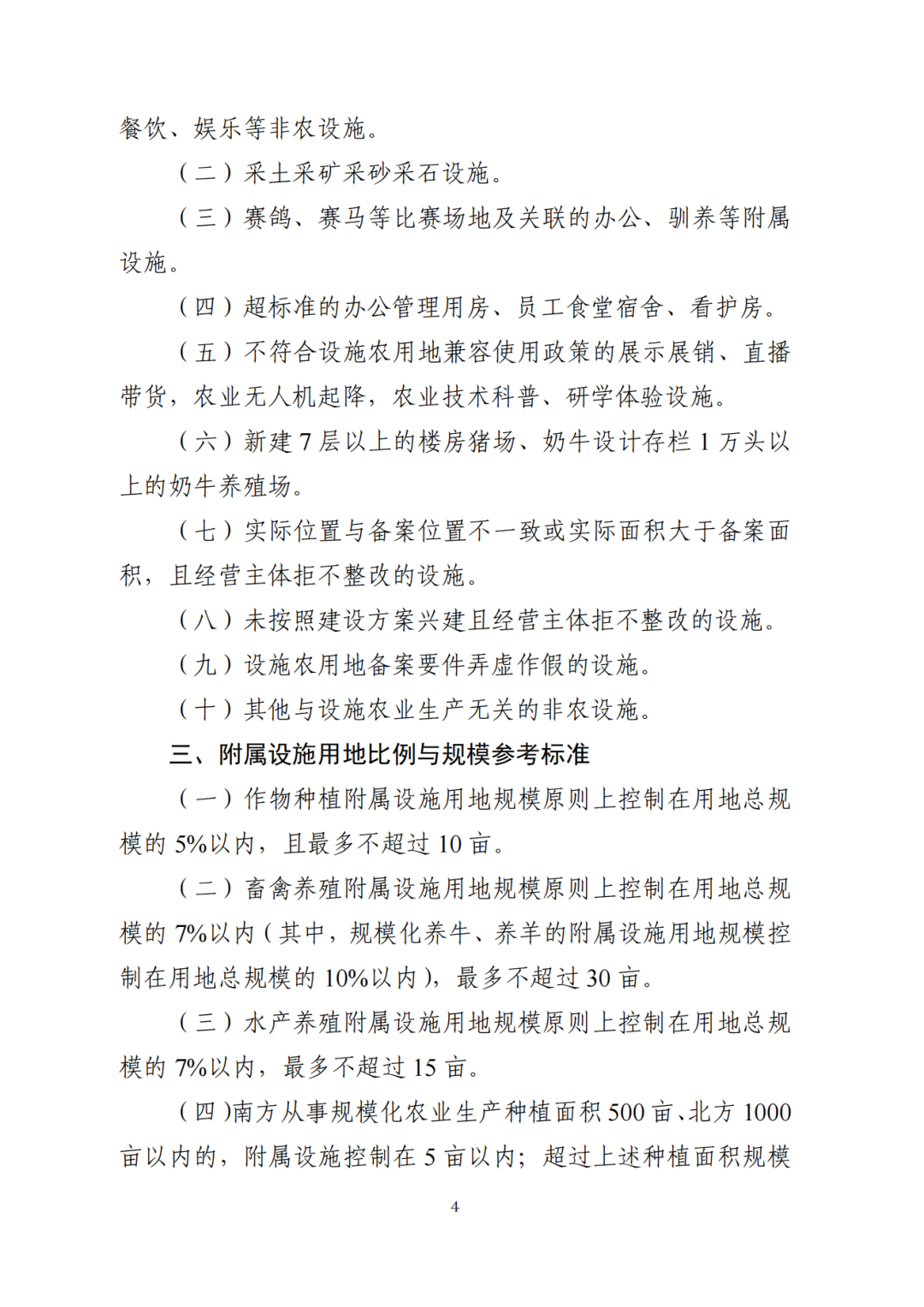
Insisting on the principle of conservation of intensive land, encouraging more direct use of agricultural land in facilities, without restrictions on the size of production facilities, and imposing a ceiling on the percentage and size of the ancillary facilities, the relevant criteria may be determined by the provincial natural resources authorities by reference to annexes or by local conditions. The scientific use of unused areas such as Gobi, deserts, saline lands, etc. for the development of modern facilities agriculture in areas where water resources are available, which do not involve the occupation of agricultural land, could be reduced proportionately in terms of the proportion and size of land used for ancillary facilities. Support for a system of total area control of agricultural land for local exploration facilities in a position to do so, which integrates food production and facility agricultural development.
IV. Regulating agricultural land for facilities
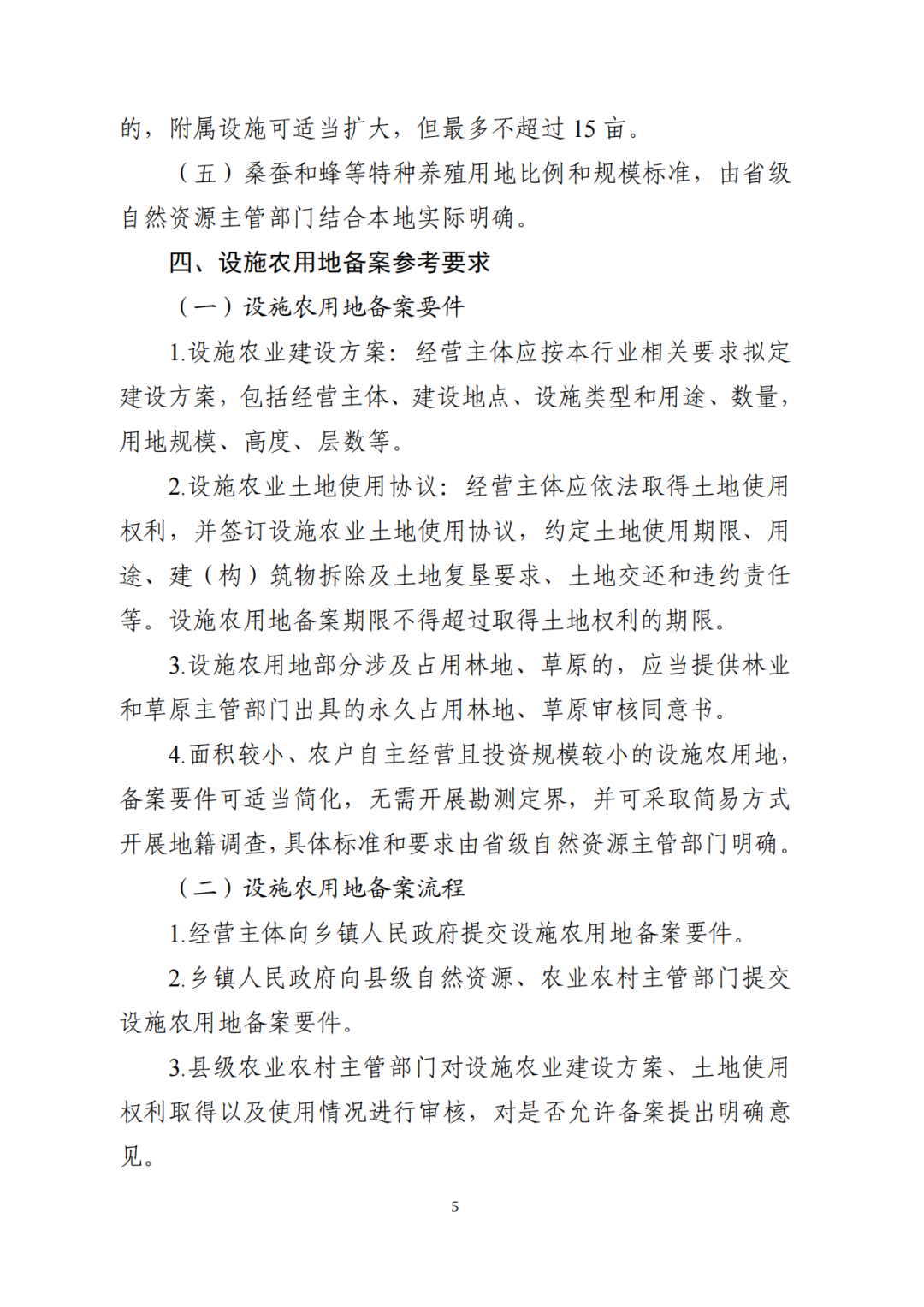
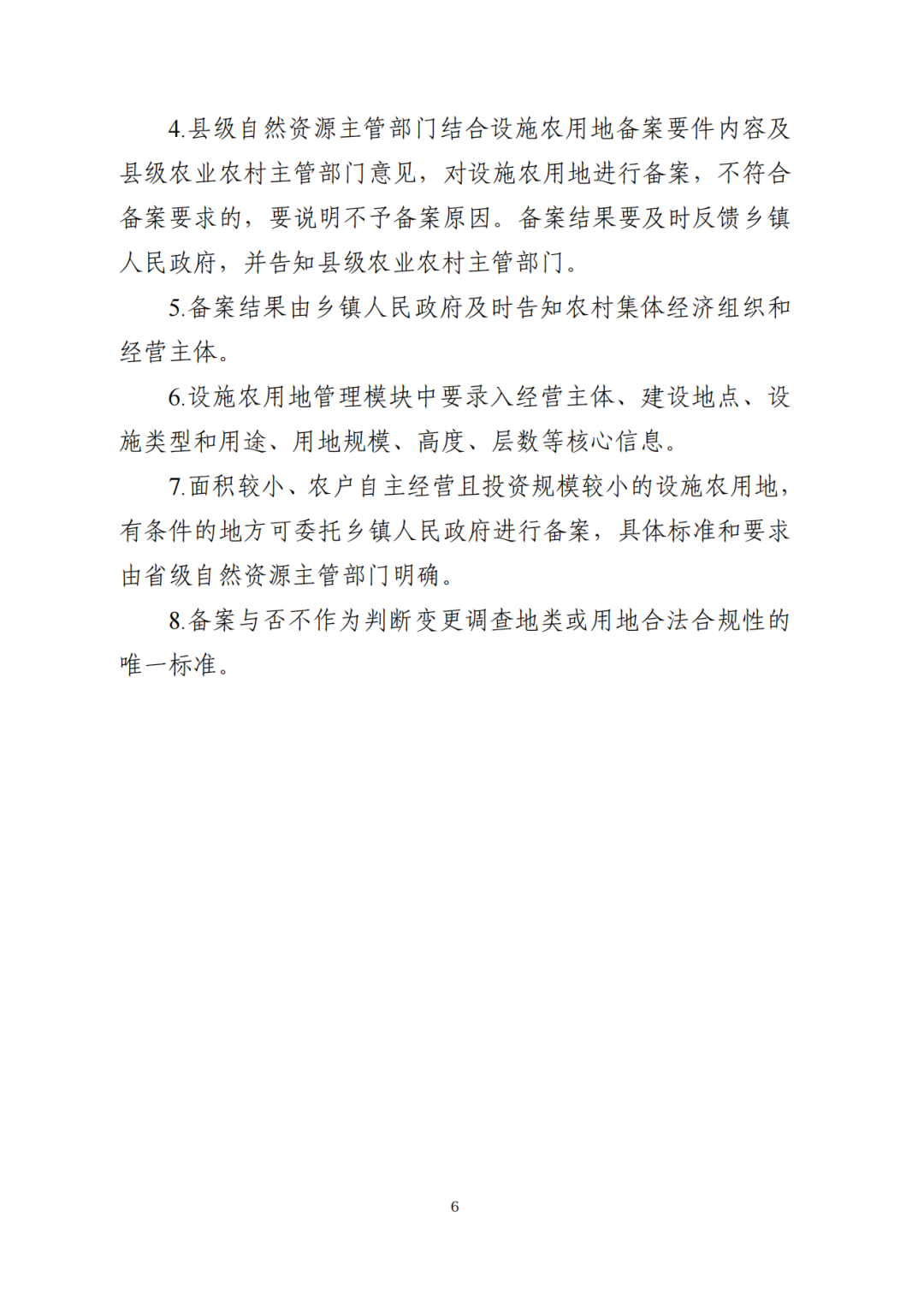
The facility's agricultural land is prepared by the county natural resources authorities, in conjunction with the county agricultural and rural authorities, on the “one map” platform of the Spatial Planning of the Territory, and the documentation elements and criteria are developed by the provincial natural resources authorities with reference to the annexes. In the case of occupied forest land, grassland, the approval of permanent occupation of forest land and grassland is carried out by the competent forestry and grassland authorities with review authority, respectively, prior to the registration of the agricultural land of the facility; in the case of occupied forest land and grassland only, the approval of permanent occupation of forest land and grassland is carried out by the competent forest and grassland authorities with review authority, respectively, and the authorization is copied to the local county natural resource authority and incorporated into the management of the agricultural land of the facility. To support the upgrading of existing facilities and the re-use of agricultural land in idle facilities and, subject to the same range of land and the absence of new expansion facilities, to make changes to other facilities for agricultural purposes, to change the subject of the operation or to the due date of the filing, the procedural changes are recorded without the need for re-filing; in the case of occupied forest lands, grasslands, the purpose of the changed facility should be consistent with the permitted area of occupied forest land, grasslands, as specified in this notification.
V. Establishment of real estate registration services
The county natural resources authorities are actively engaged in the registration of agricultural land for facilities and the construction (construction) of structures, the effective protection of interests and the support of mortgage financing. The persons concerned may apply for registration of the agricultural land of the facility and the real estate of the construction of the building, by means of materials from the sources of ownership of the agricultural land of the facility, the documentation of the agricultural land of the facility, the results of the cadastral survey and the determination of the completion of the agricultural construction of the facility issued by the county agricultural and rural authorities. Mortgage registration services are in place in a timely manner and can be made available for the benefit of the people through initial registration.
Enhanced regulation of agricultural land for facilities
The county natural resources authorities and the rural agricultural and rural authorities shall keep the facility agricultural land under strict customs clearance, shall not file the facility agricultural land for non-farm facilities, and shall not file the illegal land for packaging as agricultural land for the facility; and shall, in cases where the facility agricultural land is kept under strict supervision and included in the “negative list of agricultural land for facilities” (see annex), the county natural resources authorities shall write off the facility agricultural land for serious disposal in accordance with the law. The provincial natural resources authorities are required to establish the facility's agricultural land management module, based on a “maps” of spatial planning for the country, with full chain and life-cycle supervision.
VII. Improved mechanisms for withdrawal of agricultural land from facilities
Depending on the layout of the industry, local authorities are actively involved in the re-use of vacant agricultural land. The county natural resources authorities write off agricultural land in the facility if they have determined that the land is not renewable, have not been built for two years, have been idle for more than two years or have been unable to recover due to natural disaster damage. When agricultural land in facilities is no longer used, the county natural resources authorities, together with the agricultural rural, forestry and grassland authorities, will direct the people ' s governments of the townships to ensure that the landowners agree on the demolition and restoration of the building and its original use, involving the occupation of the forest pasture space and the restoration of the vegetation to the original land use.
Facility farming, which is managed on the basis of original land use, such as cropland, and which is no longer in operation for more than two years, shall be restored to its original condition by contractual agreement to dismantle facilities such as greenhouses.
VIII. Clarifying the responsibility for the management of agricultural land for facilities
The provincial natural resource authorities, in conjunction with the agricultural rural, forestry and grassland authorities, are expected to develop, taking into account the characteristics of the development of facilities in the region, a document on the management of agricultural land for facilities at the provincial level, refine the positive and negative list of agricultural land for facilities at the provincial level, establish criteria for the proportion and size of land for facilities attached to them, specify specific requirements such as requirements for the recording of agricultural land for facilities, processes and time frames, secure policy interfaces between old and new policies, strengthen policy advocacy, interpretation and training guidance, and guarantee the rational use of land for the development of facilities.
The natural resources, agricultural, rural, forestry and grassland authorities at all levels are required to establish joint regulatory and information-sharing mechanisms to manage the chain of responsibility and work together to promote the orderly development of facilities and agriculture, and to identify and deal with violations and long-term idleness in a timely manner and in accordance with their responsibilities. The natural resources authorities are responsible for the documentation of agricultural land in facilities, the registration of real estate property, the monitoring of information on agricultural land in facilities, and the provision of guidance on land reclamation, and are required by law to deal with issues related to the inclusion of a negative list of agricultural land in facilities. The agricultural and rural authorities are responsible for the development of standards or norms for the construction of facilities, the selection of sites for agricultural use in facilities, the review of construction programmes and the provision of guidance for construction, as well as technical guidance for the operation of production, follow-up and monitoring of agricultural use in facilities that have not been built and operated under the construction programme or that need to be withdrawn from it, and for the timely notification of the natural resources authorities. The Forestry and Grassland Authority is responsible for the audit and supervision of the facilities ' agricultural occupation of forest lands, grasslands and finds that the illegal occupation of forest lands and grasslands is dealt with in accordance with the law.
Annex: Guidelines on land for agricultural use in facilities
Ministry of Natural Resources Ministry of Agriculture and Rural Development National Forestry and Grassland Authority
24 October 2026
The content of this station, which is marked as “Sobi Photovoltaic Network”, “Carbon Thread”, and “Sobi Consulting”, is a legitimate copyright or authorized content of www.solube.com.
Authorized users are requested to use them strictly within their delegated authority and to indicate their origin in prominent locations without modification of content without permission. The violator will be held legally liable under the Copyright Act and the right to further recovery is reserved. Thank you for your support and cooperation!
 PreviousNext

The first centralized roof photovoltaic power station in the country — the Jonathan 7.2 MW project — was successfully integrated into the network: 44,000 square metres of vacant plant houses were converted to green power stations, with annual green power at 8 million degrees and several thousand tons less carbon. Sino-Zawa Energy, Trina Light Energy, Changzhou Li Xian Xinjiang Light Power, in collaboration with three generations of high power components, achieves “multi-power generation, excellence and stability”. Green and manufacturing run in both directions, setting the bar for a low-carbon transformation of manufacturing.
The first networking projects of the wide nuclear Yunnan Mount 540 MW optical volts cluster in the exclusive supply of British energy provide 156,000 N-type TopCon panda efficient components. The Ito Mountains Photovoltaic Solutions, which tackle the complex terrain and climate challenges, generate 155 million kilowatt hours of electricity annually and reduce carbon by 1,272 million tons annually, underscore the technical reliability and massive compliance power.
The one million kilowatt light-voltage sand treatment project is in the phase of social stabilization risk assessment. The project, which is located in the Sunshine Sandshire in the Sunzhou District of Wuway City, has a total investment of approximately 2,695 million yuan and plans to build 1 million kilowatt-ray arrays and associated power collection lines and ancillary facilities, as well as to synchronize ecological rehabilitation and desert management efforts, totalling 31.5 hectares. The project did not create a new 330kV pressure station, but instead accessed the 330kV pressure station planned centrally for the campus, with electricity being delivered through a one-way 330kV line to the red sand 750kV transformer station. The construction unit is Gansu Weihua Electric and New Power Company Limited, a holding subsidiary of China New Energy Group Inc. The project, which combines clean energy development with desertification control, is one of the priority projects in Gansu province to advance the light-voltage sand treatment model. (199 words)
Chongqing Zhui Construction (Group) Ltd. has recently successfully won the qualifications of two main investors in the PV project in Zhoteng County, Yunnan Province, namely, the Li Jiashan Light Volve project and the Dragon Head Shin Volt project (phase II), each planning to build 100,000 kilowatts of installed capacity totalling 200,000 kilowatts (200 MW). Both projects are located in the territory of Rudín County and include the building of the photovoltaic power plant and associated works. In accordance with the request for proposals, the project is required to become operational within eight months of the commencement of work and to be fully networked within one year of the commencement of work. The winning bid marked the official entry of Chongqing's construction into Yunnan's new energy investment and was an important step forward in expanding its clean energy operations in the south-west. (198 words)
Great Tang's silver power is intended to invest US$ 2,189.9 million in the construction of a 5 MW distributed photovoltaic project at the Three Waters of the Ring and Water Plant in Hunan City. The project, which is based on the stabilization of the power load at the water plant, gives priority to the local reduction of the amount of electricity generated, and has achieved investment documentation and construction targets for approximately four months of the construction cycle. The financial internal rate of return prior to the full investment tax on the project was measured to meet the established standards of the company and to be profitable. Companies have identified the risks of delays in approval, delays in work schedules and policy changes, and proposed four responses: optimization of design to increase the number of hours of power generation utilization, strengthening of recruitment and construction controls to reduce construction prices, implementation of finely calibrated transport to keep down costs, expansion of electricity trading and increased returns from green carbon trading. The project aims at accelerating the transformation of new energy sources in companies and enhancing long-term profitability while serving local low-carbon development goals.
The province of Hebei will systematically advance the construction of wind and photovoltaic projects at sea under the “Green-Hang Sea” Action Programme (2026-2030), focusing on the coastal areas of the three cities of Qin Emperor, Tangshan and Fuzhou. The programme integrates new energy development at sea into a low-carbon transition between green shipping and port, using the overall approach of integrated land and sea, integrated development and safety. These include: various offshore wind and electricity projects in the mountains, such as the construction of the mountain customs and Tangshan; the acceleration of the demonstration of 1.8 million kilowatts and 2 million kilowatts at sea at the Qin Emperor Island; the exploration of the “sea wind and green power company” model to achieve high-capacity industries such as port-to-port steel and chemicals at the green point-to-point supply; the promotion of diversified integration of offshore energy with marine rangelands, ocean computing power, desalination, hydrogen production and off-shore oilfield power expansion; and the simultaneous development of green manufacturing industries such as new energy vessels and smart seacraft.
This paper presents the core elements of the Programme of Action for the Development of Quality Infrastructure for Electric Car Charges in Tianjin City (2026-2030), which aims to systematically advance the systematization, intellectualization and greening upgrading of charging facilities throughout the city. The programme proposes that by 2027 and 2030 over 500,000 and 650,000 charging facilities, respectively, be built to support the need for a million-grade electric vehicle recharge; focus on the optimization of network layouts in priority areas, such as the “two-sector three centres”, with differentials driving the recharging coverage of cities, towns and remote areas; and implement eight priority actions, such as community-based construction enhancements, the construction of a specialized network for heavy trucks, the demonstration of integrated photo storage, the application of network interaction (V2G) and the extension of large power charge;
The Energy Department of Xinjiang Autonomous Region issued a Concise Manual for the Development of Energy Projects in the Autonomous Region (2026 editions), aimed at improving the transparency of energy policies and service efficiency and optimizing the business environment. The handbook focuses on such priority areas as coal, oil and gas, new energy sources and electricity. It provides a systematic overview of policy documents at the national and autonomous levels that are highly applicable and urgently needed by enterprises. It identifies the conditions for the declaration of various energy projects, lists of materials, departments that receive them, the approval process and the time frame for processing, along with a chart of the approval process. In order to facilitate communication between political parties, the manual provides simultaneous access to the various offices of the Department of Energy, and provides support for dynamic updates and free downloads on line with the “hot topic” section of the Commission's web portal (see attached). Distribution is being made to state and municipal energy authorities and to energy enterprises in border areas. This will be followed by policy adjustments to continuously refine the content, effectively supporting the landing of energy projects and helping Xinjiang to transform energy resource advantages into high-quality development dynamics. (198 words)
As recently announced, three of its light-voltage subsidiary companies, Anhui Xin Xinjiang, Jiangsu Xuan Xin Xin Xin Xin Xuan, and Anhu Xuan Xuan Xinjiang, have implemented a temporary cut-off on 8 September 2026. The number of defunct vendors has fallen sharply due to multiple pressures such as the imbalance in supply and demand in the photovoltaic sector, the continued loss of orders, the phased slowdown in domestic installed demand and the tightening of the overseas trade environment, which currently leaves all three companies without production orders. The company emphasized that the impact of this shutdown on overall business performance would be subject to the final audited financial report. In response to this dilemma, the NST is focusing on optimizing industrial structures, improving operational efficiency and profitability, and actively expanding quality photovoltaic orders, which are scheduled to resume production by 7 December 2026.
China's energy-efficient solar energy was announced on 4 November 2026 to disclose the company's progress in construction and operation in the areas of photovoltaic and storage energy from January to October 2026. During this period, the company has added 1311.24 MW to its networked photovoltaic operation, 650 MW to its new photovoltaic project and 1074.94 MW to its new filing project; and 4320 MW (power)/12287 MW-hour (energy) to its independent energy project. In terms of electricity generation, by the end of October 2026, the company had accumulated 8,394 million kilowatt-hours of electricity in that year, an increase of 17.6 per cent over the same year, and had slightly exceeded the total annual electricity generation in 2025 (an increase of 0.3 per cent over 25 million kilowatt-hours). The announcement as a whole reflected the continued expansion and steady growth of companies in the development of new energy projects, netting and actual power generation.