Rob Menendez, a U.S. New Jersey Democrat, introduced the first U.S. federal bill, Socket Full of Sunshine Act, which is aimed at impregnating and photolytic。
THE BILL IS INTENDED TO INVEST $600 MILLION OVER SIX YEARS WITHIN THE FRAMEWORK OF THE DEPARTMENT OF ENERGY (DOE) TO PROVIDE A MAXIMUM SUBSIDY OF $1,000 FOR ELIGIBLE HOUSEHOLDS AND TO REQUIRE SUBSIDIZED EQUIPMENT TO BE MANUFACTURED IN THE UNITED STATES ITSELF.
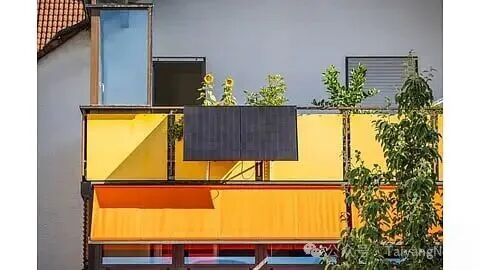
The Socket Full of Sunshine Act Act is designed to promote penetration or photovolt throughout the United States. (Source: Ingrid Balabanova/Shutterstock.com)
The United States has begun to consider expanding its application by federal legislation, following the State ' s successive push to legalize improvisation. A plug-in, or PV, or PV, typically consists of between 1.4 and 4 PV components, which can be installed on the balcony, balcony or backyard and can be directly connected to a standard household plugin to provide electricity for domestic appliances, thereby reducing the number of power withdrawals from the grid. While this is an alternative for residents who are unable to install traditional roof-voltage systems, the United States has different regulatory requirements, with some states and utility companies requiring the system to follow approval and networking processes designed for large-scale photovoltaic projects, increasing costs, particularly for tenants and apartment occupants.
To remove these barriers, the bill requires the State Public Utilities Commissions to consider removing barriers such as approval, netting agreements, fees, insurance requirements and equipment restrictions, and to establish clear safety standards for impregnated photovoltaic equipment, while requiring products to mark the expected savings in electricity by consumers. The bill will also protect the right of tenants to use, and to use, photovoltage, which the cantons are required to provide to qualify for federal subsidy funds. This is expected to extend household photovoltaic coverage from owners capable of installing roof systems to a wider population.
TheBill proposes to establish an annual Ministry of Energy grant scheme of $100 million to support state subsidies for low- and middle-income families, with a maximum subsidy of $1,000 for eligible low- and middle-income families to purchase and use photovoltaic systems for a six-year period covering the financial year 2027 to 2032.
TheBill also seeks to support indigenous manufacturing, a goal supported by the American Solar Manufacturers Union. Under the provisions of the Act, a “plug-in photovoltaic” device must be manufactured in the United States proper and the cost of spare parts purchased locally in the United States must exceed 55 per cent of the total spare parts cost in order to qualify for subsidy. Mike Carr, head of the United States Solar Manufacturers Alliance, stated: “This legislation helps to create new demand for photovoltaic products manufactured in the United States and to strengthen the supply chain in the United States by prioritizing support for products manufactured in the United States and linking federal subsidies to local manufacturing and local content requirements.”
The Bill sets out the context of the continued warming of the state-level attention to PV: Utah became the first state in the United States to legalize impregnated or photovoltaic in 2025, and in 2026 there were more than one state to follow up legislation. As of September 2026, there were 10 legal or photovoltaic states. Bright Saver, a clean energy non-profit organization, argued that the bill opened the door to energy equity for tenants and owners in 50 states in the United States, and that the Sierra Club, the New Jersey League for the Protection of Voters, the American Consumers Federation and Evergreen Action also supported the legislation.